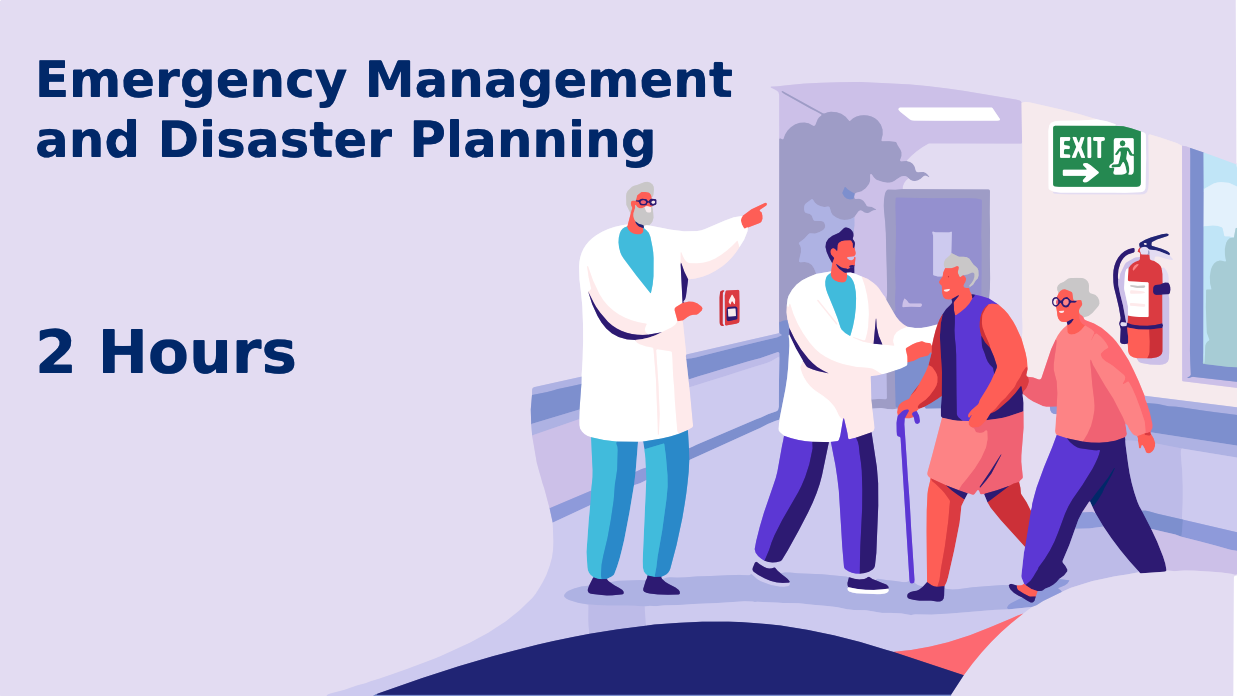
Emergency Management and Disaster Planning: Fire Safety Procedures
Tracking # 20-1395571
Category:
Click the board buttons to see the category.
Program Objectives:
- Explain Emergency and Fire Prevention Plans: Describe the purpose and essential components of an emergency action plan and a fire prevention plan.
- Identify Common Fire Hazards: Recognize fire hazards and ignition sources found in healthcare, residential, office, and community-service environments.
- Describe Fire and Alarm Reporting Procedures: Explain the appropriate steps for reporting smoke, fire, or an activated fire alarm.
- Apply Immediate Fire-Response Actions: Follow an organized sequence of fire-response actions without delaying evacuation or placing oneself in danger.
- Differentiate Evacuation and Protective Actions: Compare full evacuation, staged evacuation, horizontal relocation, and other protective actions identified in a facility’s emergency plan.
- Evaluate Exit Routes: Assess primary and secondary exit routes for obstructions, smoke exposure, accessibility, and other potential hazards.
- Apply Procedures for Individuals with Limitations: Use appropriate evacuation and relocation procedures for patients, residents, visitors, and employees with mobility, sensory, cognitive, communication, or medical limitations.
- Determine Appropriate Fire Extinguisher Use: Recognize when portable fire extinguisher use may be appropriate and when evacuation is the safest action.
- Describe Accountability and Post-Incident Procedures: Explain employee accountability, emergency communication, responder handoff, fire-drill participation, and post-incident evaluation procedures.
Course Overview:
Fire emergencies require immediate recognition, organized communication, clearly assigned responsibilities, and safe evacuation or relocation procedures. Healthcare environments may present additional challenges because patients, residents, visitors, and employees can have mobility, sensory, cognitive, medical, or communication limitations.
This two-hour course introduces the essential components of emergency management and disaster planning as they relate to fire prevention and response. Participants will examine workplace fire hazards, emergency action plans, fire prevention plans, alarm and reporting procedures, evacuation and relocation methods, exit-route safety, assistance for individuals with functional limitations, portable fire extinguisher awareness, accountability procedures, emergency drills, and post-incident improvement.
This two-hour course introduces the essential components of emergency management and disaster planning as they relate to fire prevention and response. Participants will examine workplace fire hazards, emergency action plans, fire prevention plans, alarm and reporting procedures, evacuation and relocation methods, exit-route safety, assistance for individuals with functional limitations, portable fire extinguisher awareness, accountability procedures, emergency drills, and post-incident improvement.
$8.00
2 Hours
Emergency Management and Disaster Planning: Fire Safety Procedures is offered in the packages below

Online NH Package
$23
25 Hrs

Complete ALF Admins Package
$21
25 Hrs